
Tag Archives: marketing

More and Better vs. Better Leads to More

How would you prefer to grow – as a person, as a team, as a business?

As I was working with a client CEO reviewing a recent growth plan and looking towards how we need to adapt it for the new year, the image is what I scribbled down as it popped into my mind. This concept drove the rest of our conversation as we outline that plan for the board.

So allow me to make a case for at least a balance between more and better, and a move towards defining and measuring better before you define and measure more – as a person, for your team, for your business.

(Slight aside – I am a Bears fan and have done my best to not make any reference to Good, Better, Best…)

We – as people, as teams, as businesses – default to More and Better. More friends, more connections, more people on the team or the team doing more, more at the proverbial top of the funnel, more in terms of full pipelines, more in terms of revenue and profit. And then figure out what better is by churning through the more. The process keeps us busy, makes our models and systems smarter, and so on. More certainly produces a whole lot of data.

We – as people, as teams, as businesses – tend to have something inside of us telling us what’s better. Allowing ourselves to be who we are, doing what we are good at, doing what we enjoy, what we love tends to lead to better. However, we tend to put that on the back burner as we look around and think we see so many having so much success with more.

And as we are increasingly tuned in to algorithmic-based success on digital platforms, more and better takes on an ever evolving meaning where more definitely outstrips better. And the definition of better can be lost in the desire to continually ratchet up the more.

But the authenticity of better attracts more. More of better connections with people, more of better connections with your team, more of better connections with those who are most passionate about your business. More of people who understand you better, which means you and they can make better decisions about spending more time and/or money together.

Personally, your better provides the filter for the sorts of people you want to spend your time with, and the sorts of work you want to spend your time on. Within your team, your better provides the filter for who is on your team. Within your business, better provides the filter for who you serve and how you serve them.

In the midst of your annual planning – or your annual resolution setting for that matter, make sure you understand your goals and KPIs for better. You’ll find regardless of how you define more, your better will lead to growth – as a person, as a team, as a business.
Leave a comment

Filed under Uncategorized

A Solutions and Synthesis Mindset

“Don’t go blaming the toolbox. You need the right tool for the job.”
– Bob the Builder

I grew up professionally in advertising agencies. For the first decade of my career, I was working on a wide variety of clients in a wide variety of industries with a wide variety of target audiences using a wide variety of media and technologies to go to market.

I was blessed to build and run a digital media team for most of that first decade. While the focus of the team was digital, we operated using a couple of key ideas.

First, we didn’t have to use any particular vendor, technology, or tool to solve a problem. We led with curiosity and finding the best combination of solutions to solve a problem.

Second, we believed in the adage, “Just because you can, doesn’t mean you should.” Grounded in the first idea, we were continually learning and understanding new vendors, technologies, and tools, how they worked, what they did for us and our clients. But we fought the urge to do something new for the sake of it being new.

We weren’t against “test and learn”, but we also weren’t a team with a mandate to “test and learn”. We had to prove it and invest wisely.

The balance of these two ideas allowed us to stay on the cusp of new solutions while ensuring we had a plan in place for how new solutions would deliver against KPIs – including KPIs tied to the operational efficiency of the team.

Sometimes we were leaders in applying new solutions. Sometimes we were followers. But we ALWAYS were focused on delivering results to drive the business.

And we were ALWAYS continuously learning, optimizing our results, and removing the tools that were not contributing to our KPIs.

This meant we always had a full and refreshed toolbox for solving problems. We understood what each tool did, why it was in the toolbox, and when to use it.

Across the next two decades of my career – which has also included a wide variety of businesses in a wide variety of industries with a wide variety of target audiences using a wide variety of media and technologies to go to market (as well as a pivot into operational leadership) – these two ideas have remained with me.

When determining the best way to synthesize a set of solutions to make an alphabet soup of other solutions integrate to deliver the optimal solution for customers or the optimal operational efficiency of my teams, the ideas that (1) we do not have to use any given vendor, technology, or tool to solve a problem, and (2) “Just because you can, doesn’t mean you should” do and will remain relevant.

Leave a comment

Filed under Uncategorized

AI, The No Click Future, and What We’ve Seen Before

Came across THIS BRIEF from Bain – co-authored by an awesome former colleague of mine, Megan McCurry – touting the AI-driven future of search as “zero click”. I believe this came up in a marketing newsletter of some sort two days ago, but it was published in February.

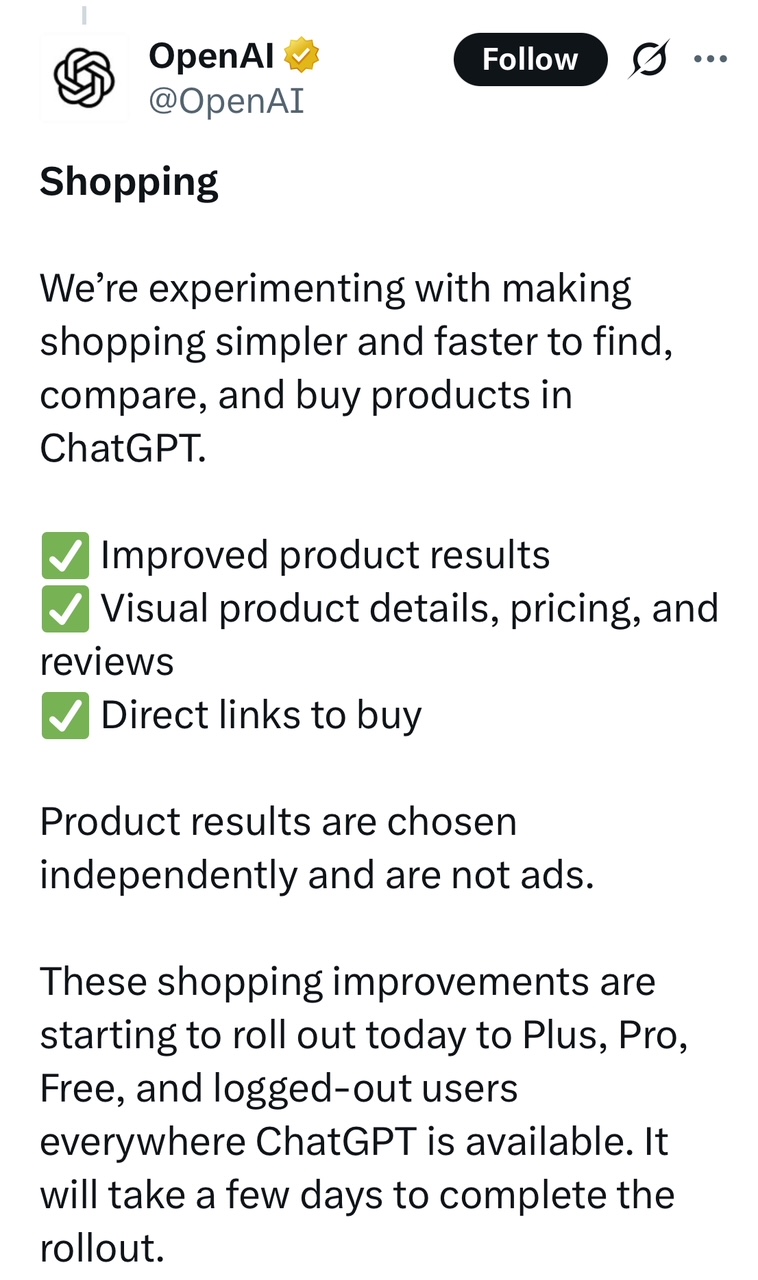
Yesterday, in a separate newsletter focused on AI, a link to the following post on X from OpenAI was published:

ZOOM IN: THREE PRACTICAL INSIGHTS
First, AI interfaces are built to provide results to queries that do not require a click or tap for the user to find what they need. Potentially some more engagement in the form of follow up queries, but it’s not a matter of type/enter/point/click. This is a very important insight in terms of how one creates and measures the effectiveness of content, especially for those who tie a lot of weight to last click attribution.

Second, that said, it’s looking like AI results will have some level of a click or a tap that will occur that will lead to a potential purchase. So while content strategy certainly needs to evolve, the zero-click future may be a bit further off than it appeared just a couple of short months ago.

Third, it seems pretty obvious where “direct links to buy” will take the AI business model, even if they say they are “not ads” – yet. I’m going to be lazy here and not look it up, but Google’s purpose or vision or insert word(s) here for the most important thing they ever wanted to do or be was to make all information available to everybody everywhere all the time – or something like that. They built one heck of an ad model from that high-fallutin’ purpose.

ZOOM OUT: WE’VE SEEN THIS BEFORE – AND WE’LL SEE MORE OF IT FASTER
In my days running a digital media team on the agency side, I’d written an article that made the point that history has shown in short order after a medium or media vehicle is created monetization via advertising and/or sponsorship of some sort tends to follow. Or it’s quite possible a medium or media vehicle was created solely to be monetized (See THIS LINK with the search “why were soap operas created” for a classic example of a media vehicle created solely for advertising/sponsorship monetization purposes – oh, and it’s a zero click search BTW. See LTK if you’d like a more modern take on a media vehicle – or platform – created solely for advertising/sponsorship monetization).

Pretty sure in that article I wrote I alluded to Moses breaking the stone tablets of the Ten Commandments after bringing them down from the mountain because he got ticked off when a PE investor approached him about sponsorship opportunities either on the tablet itself or creating a case to display the tablets that could support a larger number of sponsors. Of course, a portion of the proceeds would be set aside to aid in building the temple once they arrived in the Promised Land.

There are three main things I’d like to point out here.

First, regardless of original intent, the large majority of media, media vehicles, platforms, and so on that people use to do something or spend significant time with looking at, listening to, or manipulating in some way will be monetized or supported with advertising or sponsorship in some way.

Second, get used to change, but don’t get sucked into whatever “it” is right now being the “it” that ends all other “its”. I’m a skeptic of Kuzweil’s Law of Accelerating Returns. I’m not going to moralize at this time on whether the pace at which we may or may not be moving towards general artificial intelligence is good or bad. I’m only saying keep your head about you and realize whatever is going on right now has happened before and will happen again.

Third, don’t just think tactically about new evolutions in media. That can be easy to do. There’s always a desire to jump on the newest thing – or there’s the desire to avoid the newest thing.

Regardless, media/platform/technology usage is customer behavior. It’s telling you something about how people are getting things done or entertaining themselves. How can you use these evolutions to serve their needs with your products and services better?

And related to that, how can new media/platforms/technologies be used by YOU to do your work better/faster? What needs to happen to integrate into your existing tech/martech stack so you and your team can take advantage?

Leave a comment

Filed under Uncategorized

Strategy is…

…the most over used word in business.

So what is it? And can it be explained without using the phrase “connecting dots”?

I pull from two sources when I define strategy.

In terms of a foundational definition, I favor Patrick Lencioni’s definition from The Advantage: A collection of intentional decisions a company makes to give itself the best chance to thrive and differentiate from competitors.

In order to answer the question, “How will we succeed?”, a leadership team has to create its strategy. This is done by creating no more than three strategic anchors that will be used as filters through which all decisions will be evaluated. No spoilers here as I really love this book, but the process to get there is less than scientific and messy. And that’s OK. Oftentimes putting too much science and too many numbers into the process too soon will not allow you the chance to see opportunities to, as the definition says, thrive and differentiate.

By the way, answering “How will we succeed?” is one of six questions a business needs to answer in order to Create Clarity. Strategy must create clarity. While the process of getting there may be messy, strategy must be clear and easily understood across the organization.

To add some more color and a bit more of the “how” when it comes to strategy, I have done some synthesis and interpretation of various components of CliftonStrengths, something I’ve posted about a couple of times. Using that as a basis, I see strategy as:

  1. Spotting and synthesizing relevant patterns or issues within market analysis, customer analysis, and business analytics
  2. Generating and prioritizing ways to connect or leverage patterns, or resolve issues, seen in the data
  3. Projecting or anticipating how patterns or issues will play out
  4. Preparing alternative options to adapt or pivot when things change

I would suggest doing some reflection on how you do the work that comes before you put something into the market, what you may call “planning” to help you grok “strategy”. And, of course, do your own reading on the subject as well. There are plenty of perspectives out there.

Leave a comment

Filed under Uncategorized

Extensions of Man – from Written Language to AI

The following is not meant as criticism. It’s simply observation. And the continued curiosity I have as a communications and marketing strategist who enjoys writing to feed AI prompts just to see what comes back. In this instance, I was more curious about the meta nature of asking AI to use a generalized outline of a LinkedIn post with a prompt from a marketing professional about the positive use of AI in marketing.

It started out leaning into being sarcastic, and ended up with a good lesson in the end…yay, me for making that turn. Anyway…

Here was the prompt and the outline:

————————————————————————————————–

Can you turn the following into an actual LinkedIn post by a marketing professional about the positive use of AI in the field of marketing:

Short declarative statement.

Follow up statement that is somewhat longer providing more context.

Now things begin. It may be a story. It may just be something about professional experience. It may be the start of a perspective about a trend that is occurring. It’s most likely in short sentences. Maybe even fragments. 3-4 lines here.

Now we’re getting into it. If it’s a story there may be some dialog or situational explanation. Could be a humble brag involving a child with an incredible amount of insight for their age. Could be an epiphany that occurred out of the blue in the midst of a status meeting or client presentation. If it’s trend related, there’s insight into how this trend, technology, etc. is either (a) derivative of something else, (b) will cure the common cold, or (c) should be feared, or you shouldn’t fear it.

This is the meat of the piece. It could be all one chunk of 6-8 lines. Probably going to be a series to 2-4 lines. Main thing is that if this whole piece were to be printed, it’s maybe 2/3 to 3/4 of one side of a page of paper, or half to 2/3 is above the fold.

Short call back to initial two lines.

Two potential endings: (a) If person is at least social media famous: Call out to book / training / podcast etc. (b) Working Professional: Open ended question because (i.) truly looking to engage or (ii.) seeking to be social media famous.

————————————————————————————————–

And here’s what came back:

AI isn’t replacing marketers.
It’s making the good ones even better.

When used with intention, AI unlocks speed, insight, and creativity in ways we’ve never seen before. It’s not magic. It’s a multiplier. But only if you know what you’re multiplying.

The other day, I was reviewing a campaign brief.
Usual stuff—goals, KPIs, target audience.
Then I asked ChatGPT to push it further.
What came back wasn’t the answer. But it sparked better questions.
Ones we hadn’t thought to ask.

It wasn’t about writing copy. Or building a deck.
It was about stretching the thinking.
About reframing assumptions we didn’t know we were making.
One prompt later, our creative direction shifted—slightly, meaningfully.
And that shift got noticed. Internally. By the client. And most importantly, by the audience.

This isn’t a hand-off. It’s a handshake.
Between experience and acceleration.
Between strategy and synthesis.
Between human instinct and machine speed.

AI is showing us what’s possible.
But we still have to know what matters.

It’s not doing our job.
It’s helping us do it differently.

How are you using AI to stretch your thinking, not just your output?

#Marketing #AI #Strategy #Creativity #FutureOfWork

————————————————————————————————-

Written language. Pictures. Printing press. Photography. Telephone. Recorded sound. Broadcast sound. Recorded video. Broadcast video. Cable systems. The Internet. Streaming video. Search. AI.

All means to various ends. All, as McLuhan said, extensions of man.

The main thing has always been and remains how people use the tools at their disposal to communicate, to learn, to entertain, to buy things, to make money.

After the main thing is how are communicators, marketers, entertainers, and the like making sense of the evolution, synthesizing the insights, and activating it to improve how work is done, improve the work itself, or improve connections with various audiences.

Leave a comment

Filed under Professional