
Tag Archives: leadership

More and Better vs. Better Leads to More

How would you prefer to grow – as a person, as a team, as a business?

As I was working with a client CEO reviewing a recent growth plan and looking towards how we need to adapt it for the new year, the image is what I scribbled down as it popped into my mind. This concept drove the rest of our conversation as we outline that plan for the board.

So allow me to make a case for at least a balance between more and better, and a move towards defining and measuring better before you define and measure more – as a person, for your team, for your business.

(Slight aside – I am a Bears fan and have done my best to not make any reference to Good, Better, Best…)

We – as people, as teams, as businesses – default to More and Better. More friends, more connections, more people on the team or the team doing more, more at the proverbial top of the funnel, more in terms of full pipelines, more in terms of revenue and profit. And then figure out what better is by churning through the more. The process keeps us busy, makes our models and systems smarter, and so on. More certainly produces a whole lot of data.

We – as people, as teams, as businesses – tend to have something inside of us telling us what’s better. Allowing ourselves to be who we are, doing what we are good at, doing what we enjoy, what we love tends to lead to better. However, we tend to put that on the back burner as we look around and think we see so many having so much success with more.

And as we are increasingly tuned in to algorithmic-based success on digital platforms, more and better takes on an ever evolving meaning where more definitely outstrips better. And the definition of better can be lost in the desire to continually ratchet up the more.

But the authenticity of better attracts more. More of better connections with people, more of better connections with your team, more of better connections with those who are most passionate about your business. More of people who understand you better, which means you and they can make better decisions about spending more time and/or money together.

Personally, your better provides the filter for the sorts of people you want to spend your time with, and the sorts of work you want to spend your time on. Within your team, your better provides the filter for who is on your team. Within your business, better provides the filter for who you serve and how you serve them.

In the midst of your annual planning – or your annual resolution setting for that matter, make sure you understand your goals and KPIs for better. You’ll find regardless of how you define more, your better will lead to growth – as a person, as a team, as a business.
Leave a comment

Filed under Uncategorized

Strategy is…

…the most over used word in business.

So what is it? And can it be explained without using the phrase “connecting dots”?

I pull from two sources when I define strategy.

In terms of a foundational definition, I favor Patrick Lencioni’s definition from The Advantage: A collection of intentional decisions a company makes to give itself the best chance to thrive and differentiate from competitors.

In order to answer the question, “How will we succeed?”, a leadership team has to create its strategy. This is done by creating no more than three strategic anchors that will be used as filters through which all decisions will be evaluated. No spoilers here as I really love this book, but the process to get there is less than scientific and messy. And that’s OK. Oftentimes putting too much science and too many numbers into the process too soon will not allow you the chance to see opportunities to, as the definition says, thrive and differentiate.

By the way, answering “How will we succeed?” is one of six questions a business needs to answer in order to Create Clarity. Strategy must create clarity. While the process of getting there may be messy, strategy must be clear and easily understood across the organization.

To add some more color and a bit more of the “how” when it comes to strategy, I have done some synthesis and interpretation of various components of CliftonStrengths, something I’ve posted about a couple of times. Using that as a basis, I see strategy as:

  1. Spotting and synthesizing relevant patterns or issues within market analysis, customer analysis, and business analytics
  2. Generating and prioritizing ways to connect or leverage patterns, or resolve issues, seen in the data
  3. Projecting or anticipating how patterns or issues will play out
  4. Preparing alternative options to adapt or pivot when things change

I would suggest doing some reflection on how you do the work that comes before you put something into the market, what you may call “planning” to help you grok “strategy”. And, of course, do your own reading on the subject as well. There are plenty of perspectives out there.

Leave a comment

Filed under Uncategorized

REPOST: 5 Key Investments Leaders Need to Make (with an emphasis on Giving Encouragement)

I wrote this back in 2021. However, I got the “What’s your leadership style?” question in an interview a couple of days ago.

I was reflecting on my answer after the interview, when I recalled this post. In the interview, I focused primarily on the first three, but I led with the second – Give Encouragement. Why?

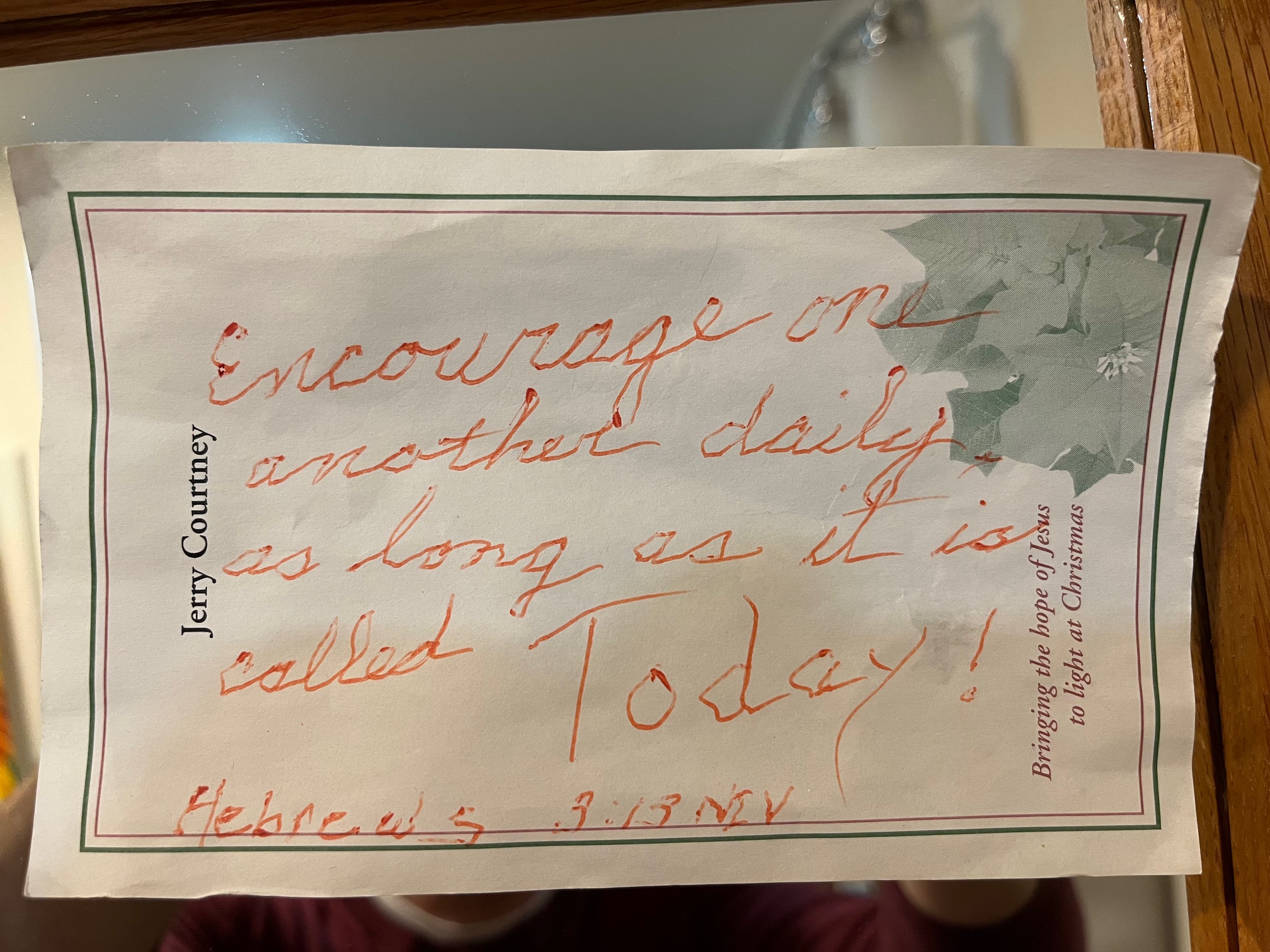
My Mom passed away in August of 2023. Taped to the mirror in the bathroom of the home where my Dad still lives and where I grew up, written in her once beautiful, but then shakily affected by arthritis, handwriting is this scripture:

The world can be cynical. It can feel like it’s filled with experts on every subject, shouting at you from all sides if you care to listen. It can make you feel less than if you allow it. It can seem like everyone is living their best life, and you’re missing out somehow if you let it.

Leaders need to provide insight. Leaders need to build up. Leaders need to provide reality and point the way. Leaders need to encourage.

—————————————————————————————–

I’m feeling especially inspired after a great sermon this morning at church. It focused on five investments in our personal relationships that unconditional love leads people to make. In and of itself, it was a powerful message for application in my personal life.

On the drive home, in a moment of lateral thinking, it struck me that these five things are applicable when it comes to professional relationships. And especially relevant when it comes to Leaders investing time and energy into the individuals on their team.

First, give instruction. But not just any instruction. Make sure you take the time to show how to do things correctly. To make sure it’s understood the instruction given is to provide the most benefit to your customers. And that those on your team are capable of giving and staying true to that instruction.

Second, give encouragement. The top pitfall that can bring people down is being discouraged. Ultimately, it can lead to apathy. That is not to say you should puff someone up if it’s not deserved, but seek to be consistent in your encouragement and keep it focused on the instructions to do things correctly. Be aware of when someone is moving into a part of their role that is challenging, or a time of year that is tougher than others. Lift people up.

Third, give affirmation. When you see someone doing something well, tell them right then. If you hear about someone doing something well, make sure they know that you know. We have so many tools to communicate with our teams these days that finding ways to give affirmation – and encouragement for that matter – should be easy. Try to do it in as real time as possible.

Fourth, give example(s). Now, this is mainly focused on the example of how you as a Leader behave, engage and go about your work. Demonstrate how your team should act by showing them in everything that you do – including and especially in how you work with them.

But I’ll extend it. Give specific examples whenever you can of your expectations. This can be scenarios provided of how to manage certain situations. This can be learning opportunities of situations that did not go well and how it could have gone better. Concrete examples are effective when it comes to instruction, encouragement and affirmation as well.

Fifth, give them a vision. I’m reinterpreting this point a bit from the sermon, but I believe it fits. As a Leader, you need to show your team that they have the opportunity to grow, to one day being not just someone who works for you, but a colleague. Help them understand what that path looks like and what it takes to be successful on it. They may want something else – which you should seek to understand – but you – and they – won’t know until the vision is given.

Leave a comment

Filed under Personal and Professional