“Don’t go blaming the toolbox. You need the right tool for the job.” – Bob the Builder
I grew up professionally in advertising agencies. For the first decade of my career, I was working on a wide variety of clients in a wide variety of industries with a wide variety of target audiences using a wide variety of media and technologies to go to market.
I was blessed to build and run a digital media team for most of that first decade. While the focus of the team was digital, we operated using a couple of key ideas.
First, we didn’t have to use any particular vendor, technology, or tool to solve a problem. We led with curiosity and finding the best combination of solutions to solve a problem.
Second, we believed in the adage, “Just because you can, doesn’t mean you should.” Grounded in the first idea, we were continually learning and understanding new vendors, technologies, and tools, how they worked, what they did for us and our clients. But we fought the urge to do something new for the sake of it being new.
We weren’t against “test and learn”, but we also weren’t a team with a mandate to “test and learn”. We had to prove it and invest wisely.
The balance of these two ideas allowed us to stay on the cusp of new solutions while ensuring we had a plan in place for how new solutions would deliver against KPIs – including KPIs tied to the operational efficiency of the team.
Sometimes we were leaders in applying new solutions. Sometimes we were followers. But we ALWAYS were focused on delivering results to drive the business.
And we were ALWAYS continuously learning, optimizing our results, and removing the tools that were not contributing to our KPIs.
This meant we always had a full and refreshed toolbox for solving problems. We understood what each tool did, why it was in the toolbox, and when to use it.
Across the next two decades of my career – which has also included a wide variety of businesses in a wide variety of industries with a wide variety of target audiences using a wide variety of media and technologies to go to market (as well as a pivot into operational leadership) – these two ideas have remained with me.
When determining the best way to synthesize a set of solutions to make an alphabet soup of other solutions integrate to deliver the optimal solution for customers or the optimal operational efficiency of my teams, the ideas that (1) we do not have to use any given vendor, technology, or tool to solve a problem, and (2) “Just because you can, doesn’t mean you should” do and will remain relevant.
From The Flaming Lips, Yoshimi Battles the Pink Robots
I’m in the midst of looking for a new job. I’ve not posted here for a few weeks as I’ve been spending time doing just that, getting acclimated to how the process works, how the tools are built, who the players are.
This is not meant as criticism. Just observation from more than a couple years of experience as a leader of people , builder of teams, and hiring manager, as well as more than a couple years of experience within digital products, digital media, segmentation, and targeting of messages along a decision path.
Observation and seeking to understand the market. I fear in my role as hiring manager I did not do enough diligence to understand the market and systems at play. And now in my role as job seeker I’m seeking to stay positive, have some empathy, but position myself optimally.
My hypotheses are:
There is an over-reliance by recruiters and hiring managers on systems (ATS) that are being used too stringently and are in the midst of evolution.
AI in the hands of job seekers is allowing the gaming of ATS leading to what appears to be an over-abundance of qualified candidates for any given role.
As with any market and system, there needs to be humans setting the strategy, staying engaged, and making the key decisions.
I send this along to you, dear reader, as I’m curious to get your thoughts…
FROM THE LEADER’S PERSPECTIVE The most popular business books on leadership and the most popular business leaders on LinkedIn will, rightly, extol the virtues of the uniqueness of the people on their teams. The coming together of these people such that the whole is greater than the sum of the parts. Many have stories where they gave someone a chance who seemed to not match a particular mold, and that person flourished. I’ve had this happen more than once in my career.
Granting macro-trends affecting the labor market from tariffs to under employment to AI and so on, it seems to be an employer’s market right now. Every market operates in cycles, so this, too, will pass.
Regardless, I have seen a decent number of open roles that interest me and to which I’ve applied. As I cannot control the macro-trends, I’m staying focused on what I have the best chance to control.
THE DANCE: JOB SEEKERS/AI/ATS/RECRUITERS/HIRING MANAGERS What I’ve seen thus far and am having confirmed through many conversations with those in my network who are both hiring managers and job seekers:
ATS, by and large, are looking for exact keyword matches. This is the primary cut when it comes to making a decision on who is interviewed.
AI is making the customization of resumes and cover letters to the exact keyword match relatively easy and efficient.
However, the AI tools tend to awkwardly place the keywords into resumes and cover letters. Or they will place them there even if the candidate doesn’t have the requisite experience the keywords reference to provide a closer match to the job description since that is the goal.
So without some editing, the resume and cover letters could pass the ATS, but may lack in terms of human readability – and truthfulness.
As more people realize how simple it is to use AI tools to align their content with keywords in job descriptions, one has to assume there is an ever increasing number of candidates for roles who look good.
ATS are most certainly being improved with AI which will alter this process and cause some more bumps in the road as AI reads AI to determine if the human is worthy of the role.
The recruiter would seem to now have a large number of candidates that appear to be good matches for the role. The question then becomes what is the next set of criteria to prioritize the candidates?
Here is the point where the job seeker loses visibility. As a hiring manager, I understand what I would do to address this, but I’m viewing this as a job seeker right now.
NETWORKING AND ATS It has been granted over and over again that the best way to find your next opportunity is by networking. My personal experience would say by and large this is true.
What I’ve seen and heard related to this is, even if you have a personal connection related to a role you’re interested in, the process will still have to flow through the ATS, then the recruiter, then the hiring manager – even if the person in your network had reached out to the hiring manager about you.
There is a good chance the benefit of the personal connection will not be seen at the hiring manager – unless the hiring manager is willing to step out of the normal process.
WHAT DO YOU THINK? WHAT DO YOU KNOW? As I said, there is no judgement in what I’ve written so far. I’m wanting to understand the market better for two reasons.
Most immediately, I’m a Job Seeker who wants to find my next job as efficiently and effectively as possible.
But at some point in the future, I will be a Hiring Manager. I will want to ensure I am able to find the best people for my team. And I will want to do it with respect for who they are first, as well as with efficiency and effectiveness.
So I ask you – what are you seeing? What do you think? In whatever role you play in this market.
Came across THIS BRIEF from Bain – co-authored by an awesome former colleague of mine, Megan McCurry – touting the AI-driven future of search as “zero click”. I believe this came up in a marketing newsletter of some sort two days ago, but it was published in February.
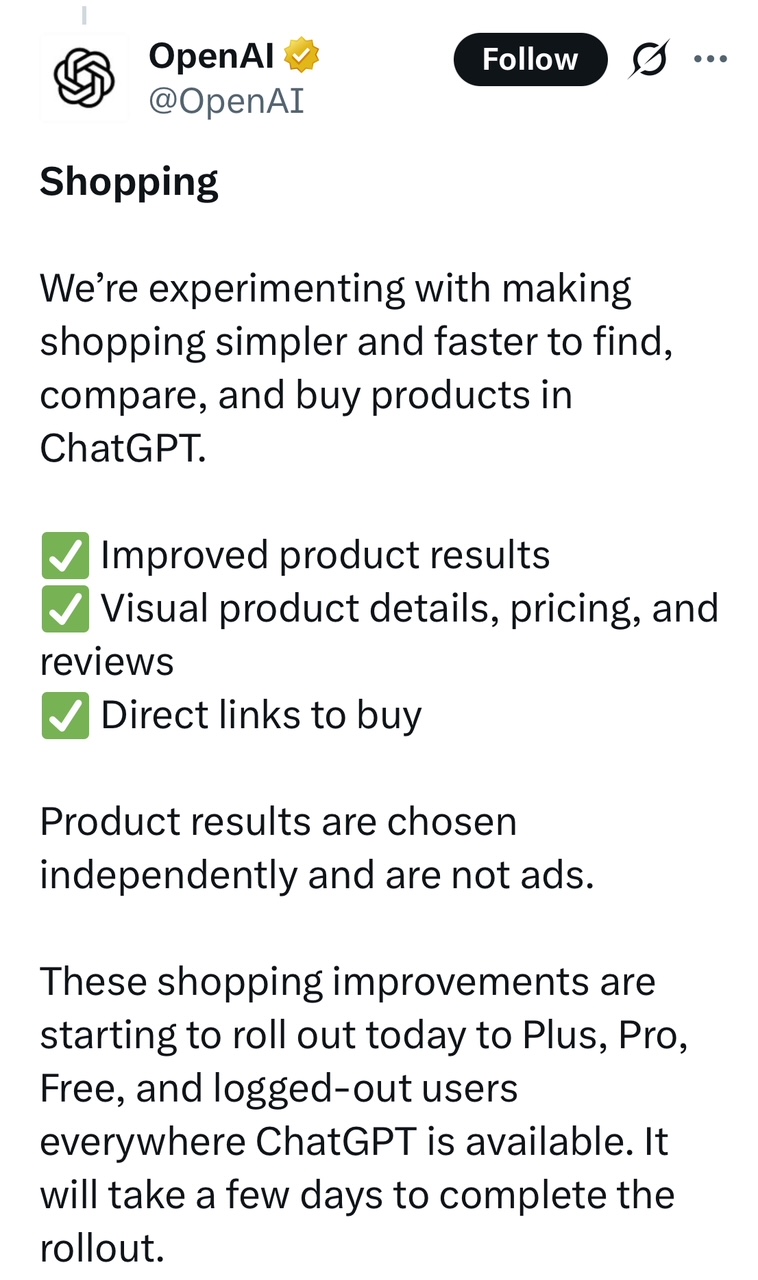
Yesterday, in a separate newsletter focused on AI, a link to the following post on X from OpenAI was published:
ZOOM IN: THREE PRACTICAL INSIGHTS First, AI interfaces are built to provide results to queries that do not require a click or tap for the user to find what they need. Potentially some more engagement in the form of follow up queries, but it’s not a matter of type/enter/point/click. This is a very important insight in terms of how one creates and measures the effectiveness of content, especially for those who tie a lot of weight to last click attribution.
Second, that said, it’s looking like AI results will have some level of a click or a tap that will occur that will lead to a potential purchase. So while content strategy certainly needs to evolve, the zero-click future may be a bit further off than it appeared just a couple of short months ago.
Third, it seems pretty obvious where “direct links to buy” will take the AI business model, even if they say they are “not ads” – yet. I’m going to be lazy here and not look it up, but Google’s purpose or vision or insert word(s) here for the most important thing they ever wanted to do or be was to make all information available to everybody everywhere all the time – or something like that. They built one heck of an ad model from that high-fallutin’ purpose.
ZOOM OUT: WE’VE SEEN THIS BEFORE – AND WE’LL SEE MORE OF IT FASTER In my days running a digital media team on the agency side, I’d written an article that made the point that history has shown in short order after a medium or media vehicle is created monetization via advertising and/or sponsorship of some sort tends to follow. Or it’s quite possible a medium or media vehicle was created solely to be monetized (See THIS LINK with the search “why were soap operas created” for a classic example of a media vehicle created solely for advertising/sponsorship monetization purposes – oh, and it’s a zero click search BTW. See LTK if you’d like a more modern take on a media vehicle – or platform – created solely for advertising/sponsorship monetization).
Pretty sure in that article I wrote I alluded to Moses breaking the stone tablets of the Ten Commandments after bringing them down from the mountain because he got ticked off when a PE investor approached him about sponsorship opportunities either on the tablet itself or creating a case to display the tablets that could support a larger number of sponsors. Of course, a portion of the proceeds would be set aside to aid in building the temple once they arrived in the Promised Land.
There are three main things I’d like to point out here.
First, regardless of original intent, the large majority of media, media vehicles, platforms, and so on that people use to do something or spend significant time with looking at, listening to, or manipulating in some way will be monetized or supported with advertising or sponsorship in some way.
Second, get used to change, but don’t get sucked into whatever “it” is right now being the “it” that ends all other “its”. I’m a skeptic of Kuzweil’s Law of Accelerating Returns. I’m not going to moralize at this time on whether the pace at which we may or may not be moving towards general artificial intelligence is good or bad. I’m only saying keep your head about you and realize whatever is going on right now has happened before and will happen again.
Third, don’t just think tactically about new evolutions in media. That can be easy to do. There’s always a desire to jump on the newest thing – or there’s the desire to avoid the newest thing.
Regardless, media/platform/technology usage is customer behavior. It’s telling you something about how people are getting things done or entertaining themselves. How can you use these evolutions to serve their needs with your products and services better?
And related to that, how can new media/platforms/technologies be used by YOU to do your work better/faster? What needs to happen to integrate into your existing tech/martech stack so you and your team can take advantage?
So what is it? And can it be explained without using the phrase “connecting dots”?
I pull from two sources when I define strategy.
In terms of a foundational definition, I favor Patrick Lencioni’s definition from The Advantage: A collection of intentional decisions a company makes to give itself the best chance to thrive and differentiate from competitors.
In order to answer the question, “How will we succeed?”, a leadership team has to create its strategy. This is done by creating no more than three strategic anchors that will be used as filters through which all decisions will be evaluated. No spoilers here as I really love this book, but the process to get there is less than scientific and messy. And that’s OK. Oftentimes putting too much science and too many numbers into the process too soon will not allow you the chance to see opportunities to, as the definition says, thrive and differentiate.
By the way, answering “How will we succeed?” is one of six questions a business needs to answer in order to Create Clarity. Strategy must create clarity. While the process of getting there may be messy, strategy must be clear and easily understood across the organization.
To add some more color and a bit more of the “how” when it comes to strategy, I have done some synthesis and interpretation of various components of CliftonStrengths, something I’ve posted about a couple of times. Using that as a basis, I see strategy as:
Spotting and synthesizing relevant patterns or issues within market analysis, customer analysis, and business analytics
Generating and prioritizing ways to connect or leverage patterns, or resolve issues, seen in the data
Projecting or anticipating how patterns or issues will play out
Preparing alternative options to adapt or pivot when things change
I would suggest doing some reflection on how you do the work that comes before you put something into the market, what you may call “planning” to help you grok “strategy”. And, of course, do your own reading on the subject as well. There are plenty of perspectives out there.