One More Thing I Learned from Failing

The other piece I wrote on the topic of failing was a practical, on the job perspective. A few steps to take in order to ensure clarity at work to do your best to avoid failing.

This one is more personal and, I think, ultimately more important.

This is more nuanced than the standard work life balance or work life integration perspective. I was blessed to learn as a younger man to not take time with my family for granted – after spending the first decade of my career doing just that. Don’t get me wrong – if you have a family, absolutely do not miss the times with them that you will never get back due to work. It is never too late to learn that lesson.

What I have learned is to not allow stressors from your work life get in the way of who YOU are as a person and what YOU enjoy doing.

Do not allow yourself to get so wrapped up in, so worried about, or so overwhelmed with what’s going on in your job that you lose who you are, or neglect things you are passionate about.

And most certainly do not let tough times at work define who you are.

For instance, if you love expressing yourself in writing, don’t go 4 years without posting to your blog. It really doesn’t matter how many readers there might be. The act of playing with ideas, finding new connections in those ideas, organizing my thoughts, then externalizing it in writing is the release for me.

And it builds on itself, keeps the mind active and turning over new learning, finding new connections. And the sharpness it produces spills into sharpness and productivity in the job.

But, more importantly, it means for my family and friends I’m more engaged, more happy, more curious, more open to new things.

Your thing may not be writing. I also love to read actual books, play golf, go to baseball games, listen to all kinds of music, and taking day trips with my lovely wife exploring places we’ve never been.

I strongly believe it’s important to bring the whole person to whatever you’re doing. I don’t believe there is a me at work and a me at home and a me with my friends and me as a writer.

All the people you touch in your life deserve to get all of you when you’re with them.

Leave a comment

Filed under Personal, Uncategorized

Strategy is…

…the most over used word in business.

So what is it? And can it be explained without using the phrase “connecting dots”?

I pull from two sources when I define strategy.

In terms of a foundational definition, I favor Patrick Lencioni’s definition from The Advantage: A collection of intentional decisions a company makes to give itself the best chance to thrive and differentiate from competitors.

In order to answer the question, “How will we succeed?”, a leadership team has to create its strategy. This is done by creating no more than three strategic anchors that will be used as filters through which all decisions will be evaluated. No spoilers here as I really love this book, but the process to get there is less than scientific and messy. And that’s OK. Oftentimes putting too much science and too many numbers into the process too soon will not allow you the chance to see opportunities to, as the definition says, thrive and differentiate.

By the way, answering “How will we succeed?” is one of six questions a business needs to answer in order to Create Clarity. Strategy must create clarity. While the process of getting there may be messy, strategy must be clear and easily understood across the organization.

To add some more color and a bit more of the “how” when it comes to strategy, I have done some synthesis and interpretation of various components of CliftonStrengths, something I’ve posted about a couple of times. Using that as a basis, I see strategy as:

  1. Spotting and synthesizing relevant patterns or issues within market analysis, customer analysis, and business analytics
  2. Generating and prioritizing ways to connect or leverage patterns, or resolve issues, seen in the data
  3. Projecting or anticipating how patterns or issues will play out
  4. Preparing alternative options to adapt or pivot when things change

I would suggest doing some reflection on how you do the work that comes before you put something into the market, what you may call “planning” to help you grok “strategy”. And, of course, do your own reading on the subject as well. There are plenty of perspectives out there.

Leave a comment

Filed under Uncategorized

What I’ve Learned from Failing

I was planning to start this piece with a quote about failure and resilience from Abraham Lincoln. He is my standby for such things. However, other than Jesus and Shakespeare, he may be the person in history with the most quotes improperly attributed to him.

Instead, I can sum up what I’ve learned about failing with this:

Lack of clarity – up, down, and sideways – leads to failure.

That isn’t to say clarity leads to success. Clarity points everyone in the right direction. You still have to do the work to make it happen and keep everyone aligned towards the right direction, making pivots when appropriate. But if you don’t start with clarity, you definitely will not get where you want to go in the time you want to get there.

Thus, what I’ve learned from failing are a few good ways to ensure clarity.

ASK. THEN BE QUIET. | or | BE QUIET. THEN ASK.

You may find yourself in a situation where you have an audience with a leader, maybe your boss or your boss’ boss, who has a vision or a strategy or a plan that you’ve had a chance to review and you’ve got questions. In this case, you ask questions and be quiet while they’re answered.

Or you may find yourself in a situation where the leader is presenting or simply stating their vision or strategy or plan, but it isn’t in writing. In this case, you’ll be quiet and ask questions when the time is appropriate.

And if you do not have a situation where you have an audience with the leader, get it. Then, ask questions and be quiet. It is very important at the outset you have clarity from the most senior person you can get an audience with on what their vision and expectations of you are.

Regardless, make sure you go into such a discussion with some set of standard questions you might use to ensure your own understanding of the current situation and desired outcome. Get as many of the questions out and answered at the outset.

And after you do this with the leader, then you need to go to your team and do the same. And then go sideways to colleagues at your level who are leading teams in other functions. Basically, you need the up, down, and sideways perspective of as much of the organization as possible.

Some leaders tend to jump to a solution, or feel they’ve done enough work to articulate what they think the solution is, and what your role in it should be. And they might be right.

When it comes to asking your team and peers, there tends to be the same type of behavior as with leaders. It’s important to see if what’s being articulated by your team and peers aligns to what you heard from the leader. Consistent alignment throughout is a good indicator of clarity.

You, however, should make no assumptions on what the situation is or what the situation calls for. Ask the questions of everyone even if you do know or think you know all or most of the answers.

And start laying the groundwork for the next steps. Ask who you need to go to in order to find data about the market, customers/segments, business analytics, CRM, martech stack, and whatever data is used to make decisions or create go to market actions. Ask who you need to go to about project management systems, documented workflows, process documents, and other systems and documents for how work gets done on the team and across teams.

Finally, and maybe most important, find out from the leader how they prefer to see strategy and plans presented to them – or if they prefer to be part of the planning process and want to see work in progress.

MAKE SENSE. DON’T ASSUME IT.

Unless you’re told otherwise, change of some sort, to some degree, is either wanted or needed. What has “worked” either isn’t working anymore, or is only addressing a part of a now evolving situation that you have been brought into address.

But you cannot address the best approaches to take without getting (1) as much data as possible about the market and the customers in the market (consumers and B2B, as well as relevant internal customers), (2) how the business currently goes to market, and (3) how the business – and your team – performs and is perceived in the market – and your team with internal customers.

Do not allow yourself to be dissuaded from finding the data you need. The data is there. Or enough data is there for an inquiring mind to build upon, cross-reference, combine, and then synthesize into the foundation of a strong story from which your strategy can be built.

Do not allow yourself to be pressured into creating a plan or making changes to the current state of things without allowing for the time needed to do this work. This is an important point in time where the old adage, “Sometimes you have to go slow to go fast” comes into play. That’s not to say you take all the time in the world here – you’re not looking for a “perfect plan”. But, more than likely, the situation you’ve been brought into is the way it is because something isn’t being looked at correctly or the right things aren’t being looked at through the right lens.

And since we’re on old adages, do not throw the baby out with the bathwater. While it is likely you are in the situation you are in to make change, there tend to be good reasons for why work is done the way it is done. Complete overhauls may be needed in some areas, but there will be areas where fine tuning is all that is required.

At this stage, it’s important that you take partners. Show your team how you do this work, what questions needed answered, how to synthesize different data, and assign some of it to them. Make it a collaborative process in some way with your peers and with those from whom you pulled data. Let them see what sort of questions you’re asking and how you are applying what you’re learning. It’s OK to have some debate and disagreement here. While you bring a level of knowledge and a different way of thinking, no one has the corner on smarts. Plus, taking the partners now will stress test your hypotheses earlier and make the work that lies ahead go more smoothly.

And if the leader, usually your boss, wants to be part of the process or see work in progress, let them see the questions you’re asking, how you’re applying what you’re learning, and what further questions you have. Let them provide guidance to ensure a tighter alignment later. I like to say I don’t want a strategy or plan to be a big reveal and a “Ta Da!” moment upwards. I much prefer it to be something with head nods and engagement already baked in.

RALLY ALL THE TROOPS. INCLUDING THE GENERALS.

Recall the last few things I mentioned when you are asking and being quiet or being quiet and asking. I said you needed to lay groundwork for what lies ahead.

I just referenced the importance of taking partners as you make sense. Notice that the partners are above you, your team, and your peers – up, down, and sideways. While upwards tends to be the most important audience for being able to execute your intentions, building up your team and ensuring alignment with your peers is what will make your plans truly powerful.

Set formal times to either workshop the plan or present the plan to your team and peers before it goes upwards. And get some partners in that presentation upwards as well. It sets a leader’s mind at ease to see a strong, cross-functional team aligned behind the clarity they’ve provided.

Regardless of the form or format of the deliverable, state your case in simple terms. Support your case with clear data points. Do it with the minimal amount of content or time required. If it comes across as obvious and simple – you’ve done some great work.

A great way to ensure clarity is to make things obvious and simple.

And clarity is the best first step to avoid failing.

Leave a comment

Filed under Uncategorized

My Favorite Cover Songs as of Now

By far, my largest Spotify playlist is one called Covers. It’s over 12 hours. I find myself tinkering around with it pretty consistently. So my favorite covers tend to change.

Didn’t feel like a clean top 5 or top 10 list, so instead here are my (current) favorite 7 covers…

I Wanna Be Your Dog – Uncle Tupelo

Wendy – Descendents

In Between Days – Ben Folds

Sympathy/Rock & Roll – Jane’s Addiction

Benny & The Jets – Biz Markie & Beastie Boys

I Want to Hold Your Hand – Melvins

Harvest Moon – The Mavericks

Gin and Juice – The Gourds

Leave a comment

Filed under Uncategorized

REPOST: 5 Key Investments Leaders Need to Make (with an emphasis on Giving Encouragement)

I wrote this back in 2021. However, I got the “What’s your leadership style?” question in an interview a couple of days ago.

I was reflecting on my answer after the interview, when I recalled this post. In the interview, I focused primarily on the first three, but I led with the second – Give Encouragement. Why?

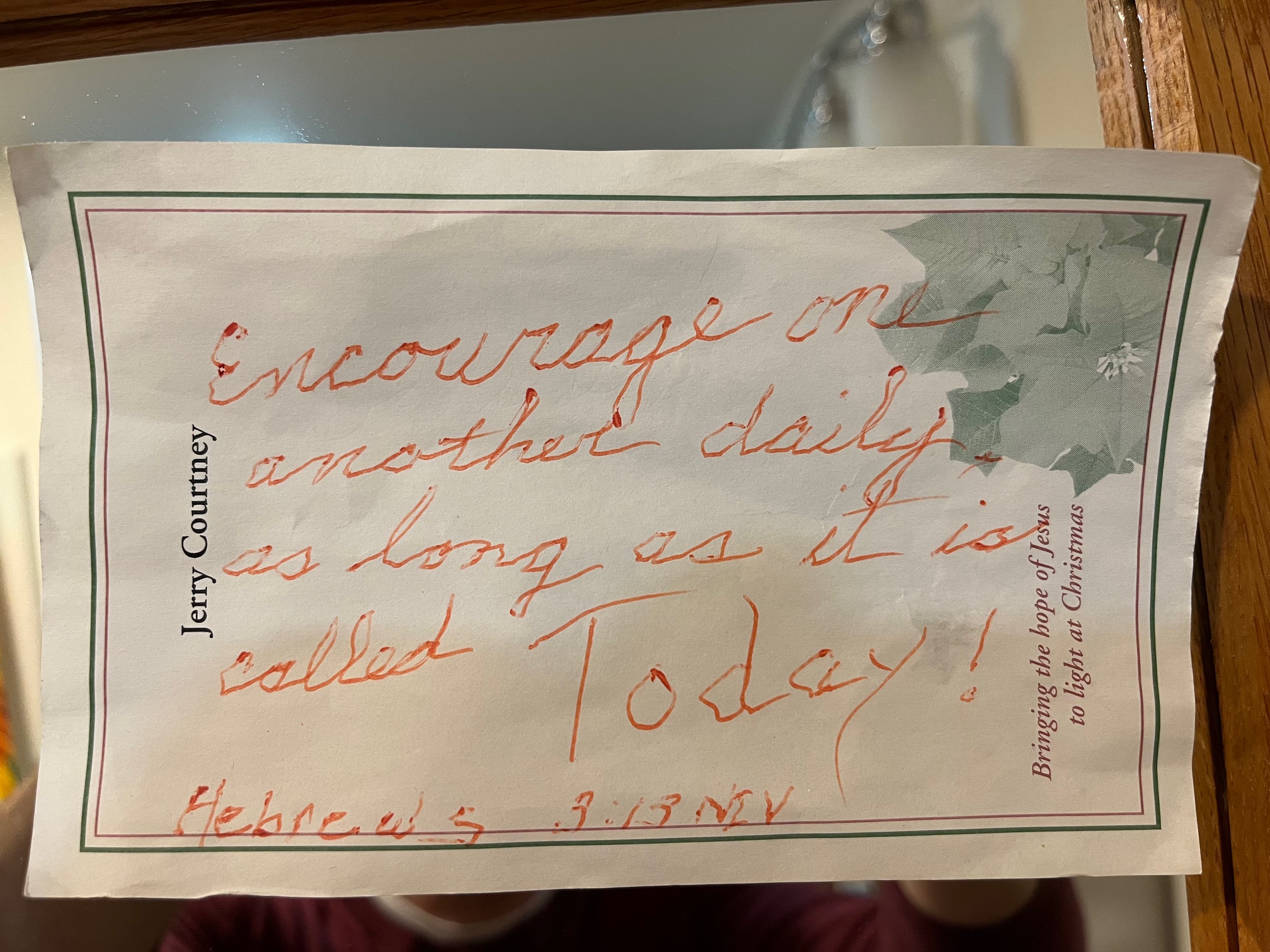
My Mom passed away in August of 2023. Taped to the mirror in the bathroom of the home where my Dad still lives and where I grew up, written in her once beautiful, but then shakily affected by arthritis, handwriting is this scripture:

The world can be cynical. It can feel like it’s filled with experts on every subject, shouting at you from all sides if you care to listen. It can make you feel less than if you allow it. It can seem like everyone is living their best life, and you’re missing out somehow if you let it.

Leaders need to provide insight. Leaders need to build up. Leaders need to provide reality and point the way. Leaders need to encourage.

—————————————————————————————–

I’m feeling especially inspired after a great sermon this morning at church. It focused on five investments in our personal relationships that unconditional love leads people to make. In and of itself, it was a powerful message for application in my personal life.

On the drive home, in a moment of lateral thinking, it struck me that these five things are applicable when it comes to professional relationships. And especially relevant when it comes to Leaders investing time and energy into the individuals on their team.

First, give instruction. But not just any instruction. Make sure you take the time to show how to do things correctly. To make sure it’s understood the instruction given is to provide the most benefit to your customers. And that those on your team are capable of giving and staying true to that instruction.

Second, give encouragement. The top pitfall that can bring people down is being discouraged. Ultimately, it can lead to apathy. That is not to say you should puff someone up if it’s not deserved, but seek to be consistent in your encouragement and keep it focused on the instructions to do things correctly. Be aware of when someone is moving into a part of their role that is challenging, or a time of year that is tougher than others. Lift people up.

Third, give affirmation. When you see someone doing something well, tell them right then. If you hear about someone doing something well, make sure they know that you know. We have so many tools to communicate with our teams these days that finding ways to give affirmation – and encouragement for that matter – should be easy. Try to do it in as real time as possible.

Fourth, give example(s). Now, this is mainly focused on the example of how you as a Leader behave, engage and go about your work. Demonstrate how your team should act by showing them in everything that you do – including and especially in how you work with them.

But I’ll extend it. Give specific examples whenever you can of your expectations. This can be scenarios provided of how to manage certain situations. This can be learning opportunities of situations that did not go well and how it could have gone better. Concrete examples are effective when it comes to instruction, encouragement and affirmation as well.

Fifth, give them a vision. I’m reinterpreting this point a bit from the sermon, but I believe it fits. As a Leader, you need to show your team that they have the opportunity to grow, to one day being not just someone who works for you, but a colleague. Help them understand what that path looks like and what it takes to be successful on it. They may want something else – which you should seek to understand – but you – and they – won’t know until the vision is given.

Leave a comment

Filed under Personal and Professional

Extensions of Man – from Written Language to AI

The following is not meant as criticism. It’s simply observation. And the continued curiosity I have as a communications and marketing strategist who enjoys writing to feed AI prompts just to see what comes back. In this instance, I was more curious about the meta nature of asking AI to use a generalized outline of a LinkedIn post with a prompt from a marketing professional about the positive use of AI in marketing.

It started out leaning into being sarcastic, and ended up with a good lesson in the end…yay, me for making that turn. Anyway…

Here was the prompt and the outline:

————————————————————————————————–

Can you turn the following into an actual LinkedIn post by a marketing professional about the positive use of AI in the field of marketing:

Short declarative statement.

Follow up statement that is somewhat longer providing more context.

Now things begin. It may be a story. It may just be something about professional experience. It may be the start of a perspective about a trend that is occurring. It’s most likely in short sentences. Maybe even fragments. 3-4 lines here.

Now we’re getting into it. If it’s a story there may be some dialog or situational explanation. Could be a humble brag involving a child with an incredible amount of insight for their age. Could be an epiphany that occurred out of the blue in the midst of a status meeting or client presentation. If it’s trend related, there’s insight into how this trend, technology, etc. is either (a) derivative of something else, (b) will cure the common cold, or (c) should be feared, or you shouldn’t fear it.

This is the meat of the piece. It could be all one chunk of 6-8 lines. Probably going to be a series to 2-4 lines. Main thing is that if this whole piece were to be printed, it’s maybe 2/3 to 3/4 of one side of a page of paper, or half to 2/3 is above the fold.

Short call back to initial two lines.

Two potential endings: (a) If person is at least social media famous: Call out to book / training / podcast etc. (b) Working Professional: Open ended question because (i.) truly looking to engage or (ii.) seeking to be social media famous.

————————————————————————————————–

And here’s what came back:

AI isn’t replacing marketers.
It’s making the good ones even better.

When used with intention, AI unlocks speed, insight, and creativity in ways we’ve never seen before. It’s not magic. It’s a multiplier. But only if you know what you’re multiplying.

The other day, I was reviewing a campaign brief.
Usual stuff—goals, KPIs, target audience.
Then I asked ChatGPT to push it further.
What came back wasn’t the answer. But it sparked better questions.
Ones we hadn’t thought to ask.

It wasn’t about writing copy. Or building a deck.
It was about stretching the thinking.
About reframing assumptions we didn’t know we were making.
One prompt later, our creative direction shifted—slightly, meaningfully.
And that shift got noticed. Internally. By the client. And most importantly, by the audience.

This isn’t a hand-off. It’s a handshake.
Between experience and acceleration.
Between strategy and synthesis.
Between human instinct and machine speed.

AI is showing us what’s possible.
But we still have to know what matters.

It’s not doing our job.
It’s helping us do it differently.

How are you using AI to stretch your thinking, not just your output?

#Marketing #AI #Strategy #Creativity #FutureOfWork

————————————————————————————————-

Written language. Pictures. Printing press. Photography. Telephone. Recorded sound. Broadcast sound. Recorded video. Broadcast video. Cable systems. The Internet. Streaming video. Search. AI.

All means to various ends. All, as McLuhan said, extensions of man.

The main thing has always been and remains how people use the tools at their disposal to communicate, to learn, to entertain, to buy things, to make money.

After the main thing is how are communicators, marketers, entertainers, and the like making sense of the evolution, synthesizing the insights, and activating it to improve how work is done, improve the work itself, or improve connections with various audiences.

Leave a comment

Filed under Professional

Managing Strengths in a Matrixed World

I’ve posted about my CliftonStrengths before. I do believe firmly that understanding and working from your strengths allows you to be more fulfilled in life and work.

What I have learned and continue to learn (yep, Learner is my #1 strength) is working from your strengths allows you to better see your potential blind spots and how to overcome your weaknesses.

3 of my top 5 strengths – Learner, Responsibility and Context – are an interesting combination of strategic thinking and execution mixed with an excitement and eagerness to use those strategic insights to further learn and improve.

I love to – quickly – connect insights to strategy and actions, measure it, improve it and do it all over again.

But not everybody loves to do that. Or not everybody loves to do that quickly. And that is not their fault.

If you move too fast, you don’t always give your team, colleagues and collaborators you need to truly be successful the opportunity to understand your insight and urgency.

While I do prefer to move quickly and tend to operate with an urgency (mainly because I have usually learned something about marketplace factors that is best exploited if acted on quickly), I have learned to allow my other 2 strengths – Relator and Individualization – to play a role.

And they don’t really slow me down. If anything, it allows all boats to rise.

Relator means I get satisfaction from close relationships and working hard with others to achieve goals.

Individualization means I am intrigued with the unique qualities of each person and able to figure out how different people can work together productively.

As work I’ve been involved with – and work in general – has become more matrixed, cross-functional and reliant on influence vs. inside a hierarchy, having Relator and Individualization as Top 5 Strengths have been valuable.

I’ve recently completed Amy Edmondson’s brilliant book, The Fearless Organization. For someone like me with a bias for action, Chapter 7 of the book provides a concrete model to allow the Relator and Individualization strengths to come out.

I won’t dive into all the detail here because I would encourage you to read the book, but there are 3 pillars to follow.

First, Set the Stage. Frame the work and emphasize the purpose to ensure all involved are grounded in what we are trying to do and why we are trying to do it.

Second, Invite Participation. Make sure all know that you do not believe you have all the answers and that we can always learn more. Be proactive with inquiry – ask questions that will open minds and encourage engagement, going broad and deep. Ensure a system and structure is in place to elicit, capture and build on ideas.

Third, Respond Productively. Express appreciation when thoughts are shared. Destigmatize failure so reaching for more can be seen as a learning experience. Sanction clear violations of the systems and structures that are set in place.

As I said, this model does not just hold when it comes to a team that reports to you. It works in matrixed, cross-functional, influence based situations as well.

1 Comment

Filed under Professional

Wanders with Rusty

Today I walked down the street I used to wander

Yeah, shook my head and made myself a bet

There were all these things I don’t think I remember

How lucky can one dog get

Lyrics from John Prine’s “How Lucky” (with one minor change).

Leave a comment

Filed under Personal

Active Open Mindedness: It’s Not What You Think, but How You Think It

As a life-long Learner with a high level of curiosity, recently reading David Epstein’s book, Range: Why Generalists Triumph in a Specialized World, has been incredibly enlightening to me.

In a chapter called Fooled by Expertise, the concept of “active open mindedness” is introduced and explored. A quote from the book:

“The best forecasters view their own ideas as hypotheses in need of testing. Their aim is not to convince their teammates of their own expertise, but to encourage their teammates to help them falsify their own notions. In the sweep of humanity, that is not normal…it is not what they think (that allows them to do well), it is how they think.”

I hope you are blessed to work in an environment where this approach can be taken. How fulfilling it is to not need to always be “right”, but rather work inside of a productive collaboration to build on ideas and thinking of those around you. That is a gold standard.

About half way through Range, I selected my next book to read. It is by Amy Edmondson, The Fearless Organization: Creating Psychological Safety in the Workplace for Learning, Innovation, and Growth. The crux of it is the gold standard I mention above. In a nutshell, how do you build a culture and teams to support the notion of Active Open Mindedness.

As I read The Fearless Organization I am seeing a number of parallels to concepts in Range. In fact, I’m already working on a post connecting learning from both. There are a couple of chapters that if cobbled together I’m feeling like make a great recipe for developing, executing, measuring and optimizing strategy. More to come on that!

Leave a comment

Filed under Professional

Interpreting Where is My Mind by Pixies

I do some really good thinking when I take my dog, Rusty, for walks. It’s usually when I get the most focused listening of podcasts or music done.

A few days ago I was listening to my Covers playlist on a walk with Rusty when Trampled by Turtles cover of Pixies Where is My Mind began to play. I can’t count the times I’ve listened to Surfer Rosa and that song in particular, let alone the cover. But for some reason I was much more dialed in to it. Perhaps a cover version that includes mandolin and accordion drew me in more.

The scribbles above came to my, um, mind as I listened, then re-listened on the walk. And then I started to consider Black Francis’, or Frank Black’s if you like, sparse lyrics.

“With your feet in the air and your head on the ground.” This is about changing or having a different perspective. Seeing things differently.

“Try this trick and spin it. Yeah!” And don’t just have a different perspective. Take some action with it and further the perspective change, learn how to do something new.

“Your head will collapse. There’s nothing in it. And you’ll ask yourself. Where is my mind?” Now here is where I started thinking a bit more deeply about this. The “mind” is a concept, the bringing together of a person’s beliefs, faith, intellect, ideas, opinions. Why would a head collapse without a “mind”?

It is because the mind is what defines who we are. It provides the strength for the brain to truly support our head. Think of the mind as providing the steel girders to support the surrounding structure of the brain (and the head in these lyrics). Without the mind, we all just have some gray matter between our ears.

So if you attempt to change your perspective without having an open mind, your head will collapse because there is no support to consider and try to understand what it is that you’re seeing and hearing. You can’t learn new things.

“Way out in the water. See it swimming?” And not having a mind to support new perspectives puts you out to sea, leads to confusion, or maybe even anger. And as the mind is a concept it can’t be seen, swimming or otherwise. And, thus, more confusion. And, further, it becomes easier to not change perspectives and learn.

Leave a comment

Filed under Personal