
Monthly Archives: April 2025

AI, The No Click Future, and What We’ve Seen Before

Came across THIS BRIEF from Bain – co-authored by an awesome former colleague of mine, Megan McCurry – touting the AI-driven future of search as “zero click”. I believe this came up in a marketing newsletter of some sort two days ago, but it was published in February.

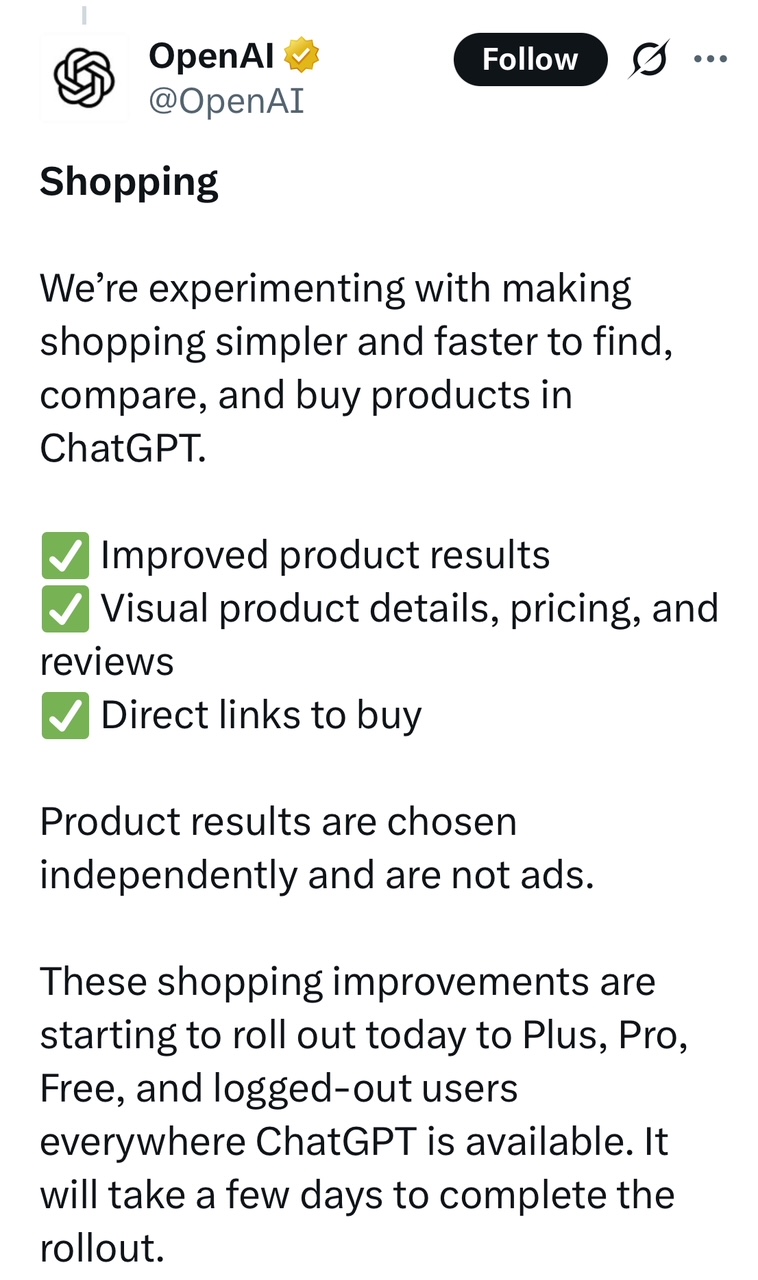
Yesterday, in a separate newsletter focused on AI, a link to the following post on X from OpenAI was published:
ZOOM IN: THREE PRACTICAL INSIGHTS
First, AI interfaces are built to provide results to queries that do not require a click or tap for the user to find what they need. Potentially some more engagement in the form of follow up queries, but it’s not a matter of type/enter/point/click. This is a very important insight in terms of how one creates and measures the effectiveness of content, especially for those who tie a lot of weight to last click attribution.

Second, that said, it’s looking like AI results will have some level of a click or a tap that will occur that will lead to a potential purchase. So while content strategy certainly needs to evolve, the zero-click future may be a bit further off than it appeared just a couple of short months ago.

Third, it seems pretty obvious where “direct links to buy” will take the AI business model, even if they say they are “not ads” – yet. I’m going to be lazy here and not look it up, but Google’s purpose or vision or insert word(s) here for the most important thing they ever wanted to do or be was to make all information available to everybody everywhere all the time – or something like that. They built one heck of an ad model from that high-fallutin’ purpose.

ZOOM OUT: WE’VE SEEN THIS BEFORE – AND WE’LL SEE MORE OF IT FASTER
In my days running a digital media team on the agency side, I’d written an article that made the point that history has shown in short order after a medium or media vehicle is created monetization via advertising and/or sponsorship of some sort tends to follow. Or it’s quite possible a medium or media vehicle was created solely to be monetized (See THIS LINK with the search “why were soap operas created” for a classic example of a media vehicle created solely for advertising/sponsorship monetization purposes – oh, and it’s a zero click search BTW. See LTK if you’d like a more modern take on a media vehicle – or platform – created solely for advertising/sponsorship monetization).

Pretty sure in that article I wrote I alluded to Moses breaking the stone tablets of the Ten Commandments after bringing them down from the mountain because he got ticked off when a PE investor approached him about sponsorship opportunities either on the tablet itself or creating a case to display the tablets that could support a larger number of sponsors. Of course, a portion of the proceeds would be set aside to aid in building the temple once they arrived in the Promised Land.

There are three main things I’d like to point out here.

First, regardless of original intent, the large majority of media, media vehicles, platforms, and so on that people use to do something or spend significant time with looking at, listening to, or manipulating in some way will be monetized or supported with advertising or sponsorship in some way.

Second, get used to change, but don’t get sucked into whatever “it” is right now being the “it” that ends all other “its”. I’m a skeptic of Kuzweil’s Law of Accelerating Returns. I’m not going to moralize at this time on whether the pace at which we may or may not be moving towards general artificial intelligence is good or bad. I’m only saying keep your head about you and realize whatever is going on right now has happened before and will happen again.

Third, don’t just think tactically about new evolutions in media. That can be easy to do. There’s always a desire to jump on the newest thing – or there’s the desire to avoid the newest thing.

Regardless, media/platform/technology usage is customer behavior. It’s telling you something about how people are getting things done or entertaining themselves. How can you use these evolutions to serve their needs with your products and services better?

And related to that, how can new media/platforms/technologies be used by YOU to do your work better/faster? What needs to happen to integrate into your existing tech/martech stack so you and your team can take advantage?
Leave a comment

Filed under Uncategorized

My Favorite Compilation Albums: Greatest Hits

Thinking about this exercise took me to vivid places in my memories between roughly 1979 and 1997. Yes, these are the musings of a mid-to-late Gen X’er.

The “Compilation” album is fertile territory for a writer who enjoys music of many kinds. I’m seeing a few pieces along this vein coming.

This exercise, and any that follow related to music, books, movies, etc, is one of personal favorites. Not “the greatest” or “the best”. There was not an intensive list making process followed by creation of analytical tools to rank, followed by a final use of whiteboards and/or sticky notes to order and reorder things qualitatively to truly get things where they should be. The Good Lord knows I had to fight that urge because I would enjoy the process.

No, I didn’t go there. I believe there are parts of life that are best left outside of a data-driven approach to define what is “good”. I think art is meant to, loosely quoting Emerson, belong to the eyes that see it, the ears that hear it, the memories or feelings provoked by it.

My Favorite: Tom Petty & the Heartbreakers Greatest Hits (1993 release)

This CD was, I think, in the last cache of ones I got from Columbia House. Which means I also had Steve Miller Band’s Greatest Hits, (at least the first one), Eagles Greatest Hits (at least the first one), and Jimmy Buffett Songs You Know by Heart.

Again, the musings of a mid-to-late Gen X’er who grew up in a small, Midwestern town on rock/classic rock radio of the late 70s-early 90s when what streamed to you in terms of music were post cards from mail order music services.

Reflecting on this one, Tom Petty the lyricist is like Ernest Hemingway. Nothing is wasted. No more is said than what is needed. No need for over wrought adornment. You know what he means. Like you’re sitting across a table from him, having a conversation. It’s not like he sees into your soul. It’s more like he hears you out, nods his head, and provides a better, crystal clear articulation of what you meant.

The revelation was just how good this band was. “Tight” is the best way to describe it. Hooks, melodies, layers. Yet they seemed like they could be the best garage band of all time.

Yes, I realize there were a few songs from Full Moon Fever, Tom Petty technically “solo”, but the backing band for that album was mostly The Heartbreakers. I’d rather not quibble over that.

Leave a comment

Filed under Uncategorized

One More Thing I Learned from Failing

The other piece I wrote on the topic of failing was a practical, on the job perspective. A few steps to take in order to ensure clarity at work to do your best to avoid failing.

This one is more personal and, I think, ultimately more important.

This is more nuanced than the standard work life balance or work life integration perspective. I was blessed to learn as a younger man to not take time with my family for granted – after spending the first decade of my career doing just that. Don’t get me wrong – if you have a family, absolutely do not miss the times with them that you will never get back due to work. It is never too late to learn that lesson.

What I have learned is to not allow stressors from your work life get in the way of who YOU are as a person and what YOU enjoy doing.

Do not allow yourself to get so wrapped up in, so worried about, or so overwhelmed with what’s going on in your job that you lose who you are, or neglect things you are passionate about.

And most certainly do not let tough times at work define who you are.

For instance, if you love expressing yourself in writing, don’t go 4 years without posting to your blog. It really doesn’t matter how many readers there might be. The act of playing with ideas, finding new connections in those ideas, organizing my thoughts, then externalizing it in writing is the release for me.

And it builds on itself, keeps the mind active and turning over new learning, finding new connections. And the sharpness it produces spills into sharpness and productivity in the job.

But, more importantly, it means for my family and friends I’m more engaged, more happy, more curious, more open to new things.

Your thing may not be writing. I also love to read actual books, play golf, go to baseball games, listen to all kinds of music, and taking day trips with my lovely wife exploring places we’ve never been.

I strongly believe it’s important to bring the whole person to whatever you’re doing. I don’t believe there is a me at work and a me at home and a me with my friends and me as a writer.

All the people you touch in your life deserve to get all of you when you’re with them.

Leave a comment

Filed under Personal, Uncategorized

Strategy is…

…the most over used word in business.

So what is it? And can it be explained without using the phrase “connecting dots”?

I pull from two sources when I define strategy.

In terms of a foundational definition, I favor Patrick Lencioni’s definition from The Advantage: A collection of intentional decisions a company makes to give itself the best chance to thrive and differentiate from competitors.

In order to answer the question, “How will we succeed?”, a leadership team has to create its strategy. This is done by creating no more than three strategic anchors that will be used as filters through which all decisions will be evaluated. No spoilers here as I really love this book, but the process to get there is less than scientific and messy. And that’s OK. Oftentimes putting too much science and too many numbers into the process too soon will not allow you the chance to see opportunities to, as the definition says, thrive and differentiate.

By the way, answering “How will we succeed?” is one of six questions a business needs to answer in order to Create Clarity. Strategy must create clarity. While the process of getting there may be messy, strategy must be clear and easily understood across the organization.

To add some more color and a bit more of the “how” when it comes to strategy, I have done some synthesis and interpretation of various components of CliftonStrengths, something I’ve posted about a couple of times. Using that as a basis, I see strategy as:

  1. Spotting and synthesizing relevant patterns or issues within market analysis, customer analysis, and business analytics
  2. Generating and prioritizing ways to connect or leverage patterns, or resolve issues, seen in the data
  3. Projecting or anticipating how patterns or issues will play out
  4. Preparing alternative options to adapt or pivot when things change

I would suggest doing some reflection on how you do the work that comes before you put something into the market, what you may call “planning” to help you grok “strategy”. And, of course, do your own reading on the subject as well. There are plenty of perspectives out there.

Leave a comment

Filed under Uncategorized

What I’ve Learned from Failing

I was planning to start this piece with a quote about failure and resilience from Abraham Lincoln. He is my standby for such things. However, other than Jesus and Shakespeare, he may be the person in history with the most quotes improperly attributed to him.

Instead, I can sum up what I’ve learned about failing with this:

Lack of clarity – up, down, and sideways – leads to failure.

That isn’t to say clarity leads to success. Clarity points everyone in the right direction. You still have to do the work to make it happen and keep everyone aligned towards the right direction, making pivots when appropriate. But if you don’t start with clarity, you definitely will not get where you want to go in the time you want to get there.

Thus, what I’ve learned from failing are a few good ways to ensure clarity.

ASK. THEN BE QUIET. | or | BE QUIET. THEN ASK.

You may find yourself in a situation where you have an audience with a leader, maybe your boss or your boss’ boss, who has a vision or a strategy or a plan that you’ve had a chance to review and you’ve got questions. In this case, you ask questions and be quiet while they’re answered.

Or you may find yourself in a situation where the leader is presenting or simply stating their vision or strategy or plan, but it isn’t in writing. In this case, you’ll be quiet and ask questions when the time is appropriate.

And if you do not have a situation where you have an audience with the leader, get it. Then, ask questions and be quiet. It is very important at the outset you have clarity from the most senior person you can get an audience with on what their vision and expectations of you are.

Regardless, make sure you go into such a discussion with some set of standard questions you might use to ensure your own understanding of the current situation and desired outcome. Get as many of the questions out and answered at the outset.

And after you do this with the leader, then you need to go to your team and do the same. And then go sideways to colleagues at your level who are leading teams in other functions. Basically, you need the up, down, and sideways perspective of as much of the organization as possible.

Some leaders tend to jump to a solution, or feel they’ve done enough work to articulate what they think the solution is, and what your role in it should be. And they might be right.

When it comes to asking your team and peers, there tends to be the same type of behavior as with leaders. It’s important to see if what’s being articulated by your team and peers aligns to what you heard from the leader. Consistent alignment throughout is a good indicator of clarity.

You, however, should make no assumptions on what the situation is or what the situation calls for. Ask the questions of everyone even if you do know or think you know all or most of the answers.

And start laying the groundwork for the next steps. Ask who you need to go to in order to find data about the market, customers/segments, business analytics, CRM, martech stack, and whatever data is used to make decisions or create go to market actions. Ask who you need to go to about project management systems, documented workflows, process documents, and other systems and documents for how work gets done on the team and across teams.

Finally, and maybe most important, find out from the leader how they prefer to see strategy and plans presented to them – or if they prefer to be part of the planning process and want to see work in progress.

MAKE SENSE. DON’T ASSUME IT.

Unless you’re told otherwise, change of some sort, to some degree, is either wanted or needed. What has “worked” either isn’t working anymore, or is only addressing a part of a now evolving situation that you have been brought into address.

But you cannot address the best approaches to take without getting (1) as much data as possible about the market and the customers in the market (consumers and B2B, as well as relevant internal customers), (2) how the business currently goes to market, and (3) how the business – and your team – performs and is perceived in the market – and your team with internal customers.

Do not allow yourself to be dissuaded from finding the data you need. The data is there. Or enough data is there for an inquiring mind to build upon, cross-reference, combine, and then synthesize into the foundation of a strong story from which your strategy can be built.

Do not allow yourself to be pressured into creating a plan or making changes to the current state of things without allowing for the time needed to do this work. This is an important point in time where the old adage, “Sometimes you have to go slow to go fast” comes into play. That’s not to say you take all the time in the world here – you’re not looking for a “perfect plan”. But, more than likely, the situation you’ve been brought into is the way it is because something isn’t being looked at correctly or the right things aren’t being looked at through the right lens.

And since we’re on old adages, do not throw the baby out with the bathwater. While it is likely you are in the situation you are in to make change, there tend to be good reasons for why work is done the way it is done. Complete overhauls may be needed in some areas, but there will be areas where fine tuning is all that is required.

At this stage, it’s important that you take partners. Show your team how you do this work, what questions needed answered, how to synthesize different data, and assign some of it to them. Make it a collaborative process in some way with your peers and with those from whom you pulled data. Let them see what sort of questions you’re asking and how you are applying what you’re learning. It’s OK to have some debate and disagreement here. While you bring a level of knowledge and a different way of thinking, no one has the corner on smarts. Plus, taking the partners now will stress test your hypotheses earlier and make the work that lies ahead go more smoothly.

And if the leader, usually your boss, wants to be part of the process or see work in progress, let them see the questions you’re asking, how you’re applying what you’re learning, and what further questions you have. Let them provide guidance to ensure a tighter alignment later. I like to say I don’t want a strategy or plan to be a big reveal and a “Ta Da!” moment upwards. I much prefer it to be something with head nods and engagement already baked in.

RALLY ALL THE TROOPS. INCLUDING THE GENERALS.

Recall the last few things I mentioned when you are asking and being quiet or being quiet and asking. I said you needed to lay groundwork for what lies ahead.

I just referenced the importance of taking partners as you make sense. Notice that the partners are above you, your team, and your peers – up, down, and sideways. While upwards tends to be the most important audience for being able to execute your intentions, building up your team and ensuring alignment with your peers is what will make your plans truly powerful.

Set formal times to either workshop the plan or present the plan to your team and peers before it goes upwards. And get some partners in that presentation upwards as well. It sets a leader’s mind at ease to see a strong, cross-functional team aligned behind the clarity they’ve provided.

Regardless of the form or format of the deliverable, state your case in simple terms. Support your case with clear data points. Do it with the minimal amount of content or time required. If it comes across as obvious and simple – you’ve done some great work.

A great way to ensure clarity is to make things obvious and simple.

And clarity is the best first step to avoid failing.

Leave a comment

Filed under Uncategorized

My Favorite Cover Songs as of Now

By far, my largest Spotify playlist is one called Covers. It’s over 12 hours. I find myself tinkering around with it pretty consistently. So my favorite covers tend to change.

Didn’t feel like a clean top 5 or top 10 list, so instead here are my (current) favorite 7 covers…

I Wanna Be Your Dog – Uncle Tupelo

Wendy – Descendents

In Between Days – Ben Folds

Sympathy/Rock & Roll – Jane’s Addiction

Benny & The Jets – Biz Markie & Beastie Boys

I Want to Hold Your Hand – Melvins

Harvest Moon – The Mavericks

Gin and Juice – The Gourds

Leave a comment

Filed under Uncategorized

REPOST: 5 Key Investments Leaders Need to Make (with an emphasis on Giving Encouragement)

I wrote this back in 2021. However, I got the “What’s your leadership style?” question in an interview a couple of days ago.

I was reflecting on my answer after the interview, when I recalled this post. In the interview, I focused primarily on the first three, but I led with the second – Give Encouragement. Why?

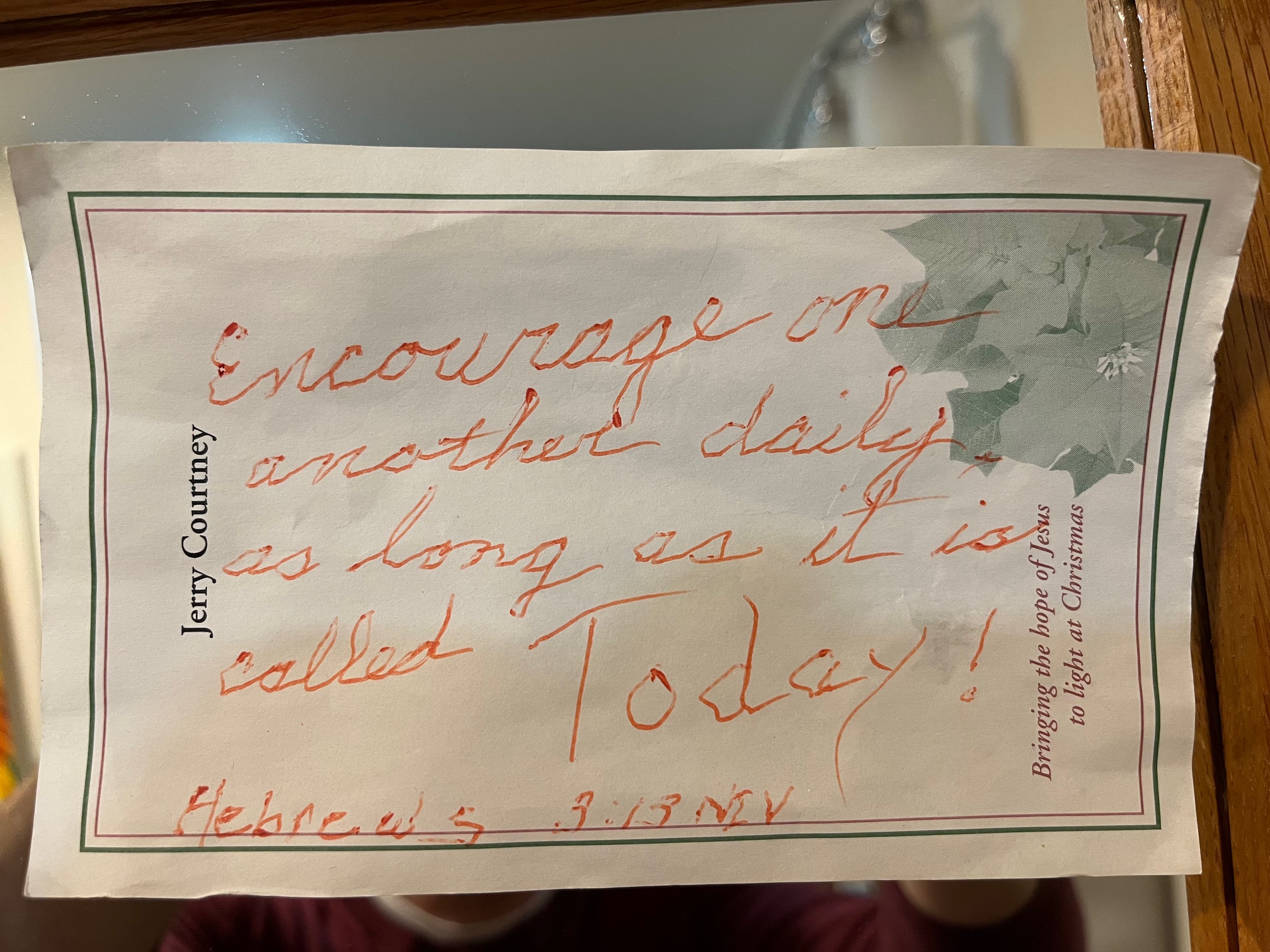
My Mom passed away in August of 2023. Taped to the mirror in the bathroom of the home where my Dad still lives and where I grew up, written in her once beautiful, but then shakily affected by arthritis, handwriting is this scripture:

The world can be cynical. It can feel like it’s filled with experts on every subject, shouting at you from all sides if you care to listen. It can make you feel less than if you allow it. It can seem like everyone is living their best life, and you’re missing out somehow if you let it.

Leaders need to provide insight. Leaders need to build up. Leaders need to provide reality and point the way. Leaders need to encourage.

—————————————————————————————–

I’m feeling especially inspired after a great sermon this morning at church. It focused on five investments in our personal relationships that unconditional love leads people to make. In and of itself, it was a powerful message for application in my personal life.

On the drive home, in a moment of lateral thinking, it struck me that these five things are applicable when it comes to professional relationships. And especially relevant when it comes to Leaders investing time and energy into the individuals on their team.

First, give instruction. But not just any instruction. Make sure you take the time to show how to do things correctly. To make sure it’s understood the instruction given is to provide the most benefit to your customers. And that those on your team are capable of giving and staying true to that instruction.

Second, give encouragement. The top pitfall that can bring people down is being discouraged. Ultimately, it can lead to apathy. That is not to say you should puff someone up if it’s not deserved, but seek to be consistent in your encouragement and keep it focused on the instructions to do things correctly. Be aware of when someone is moving into a part of their role that is challenging, or a time of year that is tougher than others. Lift people up.

Third, give affirmation. When you see someone doing something well, tell them right then. If you hear about someone doing something well, make sure they know that you know. We have so many tools to communicate with our teams these days that finding ways to give affirmation – and encouragement for that matter – should be easy. Try to do it in as real time as possible.

Fourth, give example(s). Now, this is mainly focused on the example of how you as a Leader behave, engage and go about your work. Demonstrate how your team should act by showing them in everything that you do – including and especially in how you work with them.

But I’ll extend it. Give specific examples whenever you can of your expectations. This can be scenarios provided of how to manage certain situations. This can be learning opportunities of situations that did not go well and how it could have gone better. Concrete examples are effective when it comes to instruction, encouragement and affirmation as well.

Fifth, give them a vision. I’m reinterpreting this point a bit from the sermon, but I believe it fits. As a Leader, you need to show your team that they have the opportunity to grow, to one day being not just someone who works for you, but a colleague. Help them understand what that path looks like and what it takes to be successful on it. They may want something else – which you should seek to understand – but you – and they – won’t know until the vision is given.

Leave a comment

Filed under Personal and Professional

Extensions of Man – from Written Language to AI

The following is not meant as criticism. It’s simply observation. And the continued curiosity I have as a communications and marketing strategist who enjoys writing to feed AI prompts just to see what comes back. In this instance, I was more curious about the meta nature of asking AI to use a generalized outline of a LinkedIn post with a prompt from a marketing professional about the positive use of AI in marketing.

It started out leaning into being sarcastic, and ended up with a good lesson in the end…yay, me for making that turn. Anyway…

Here was the prompt and the outline:

————————————————————————————————–

Can you turn the following into an actual LinkedIn post by a marketing professional about the positive use of AI in the field of marketing:

Short declarative statement.

Follow up statement that is somewhat longer providing more context.

Now things begin. It may be a story. It may just be something about professional experience. It may be the start of a perspective about a trend that is occurring. It’s most likely in short sentences. Maybe even fragments. 3-4 lines here.

Now we’re getting into it. If it’s a story there may be some dialog or situational explanation. Could be a humble brag involving a child with an incredible amount of insight for their age. Could be an epiphany that occurred out of the blue in the midst of a status meeting or client presentation. If it’s trend related, there’s insight into how this trend, technology, etc. is either (a) derivative of something else, (b) will cure the common cold, or (c) should be feared, or you shouldn’t fear it.

This is the meat of the piece. It could be all one chunk of 6-8 lines. Probably going to be a series to 2-4 lines. Main thing is that if this whole piece were to be printed, it’s maybe 2/3 to 3/4 of one side of a page of paper, or half to 2/3 is above the fold.

Short call back to initial two lines.

Two potential endings: (a) If person is at least social media famous: Call out to book / training / podcast etc. (b) Working Professional: Open ended question because (i.) truly looking to engage or (ii.) seeking to be social media famous.

————————————————————————————————–

And here’s what came back:

AI isn’t replacing marketers.
It’s making the good ones even better.

When used with intention, AI unlocks speed, insight, and creativity in ways we’ve never seen before. It’s not magic. It’s a multiplier. But only if you know what you’re multiplying.

The other day, I was reviewing a campaign brief.
Usual stuff—goals, KPIs, target audience.
Then I asked ChatGPT to push it further.
What came back wasn’t the answer. But it sparked better questions.
Ones we hadn’t thought to ask.

It wasn’t about writing copy. Or building a deck.
It was about stretching the thinking.
About reframing assumptions we didn’t know we were making.
One prompt later, our creative direction shifted—slightly, meaningfully.
And that shift got noticed. Internally. By the client. And most importantly, by the audience.

This isn’t a hand-off. It’s a handshake.
Between experience and acceleration.
Between strategy and synthesis.
Between human instinct and machine speed.

AI is showing us what’s possible.
But we still have to know what matters.

It’s not doing our job.
It’s helping us do it differently.

How are you using AI to stretch your thinking, not just your output?

#Marketing #AI #Strategy #Creativity #FutureOfWork

————————————————————————————————-

Written language. Pictures. Printing press. Photography. Telephone. Recorded sound. Broadcast sound. Recorded video. Broadcast video. Cable systems. The Internet. Streaming video. Search. AI.

All means to various ends. All, as McLuhan said, extensions of man.

The main thing has always been and remains how people use the tools at their disposal to communicate, to learn, to entertain, to buy things, to make money.

After the main thing is how are communicators, marketers, entertainers, and the like making sense of the evolution, synthesizing the insights, and activating it to improve how work is done, improve the work itself, or improve connections with various audiences.

Leave a comment

Filed under Professional